


latest News

Minimalist sandals are our life!
When Lena and I started Xero Shoes in November 2009, we thought, "Oh, this'll be a nice little hobby business." We never anticipated it growing as much as it has, or working as hard as we work ;-)After appearing on Shark Tank last night, we've been SWAMPED with orders, emails, phone calls.I've been awake and on my feet (I have a treadmill desk) for about 40 hours (don't even ask me about the list of technical problems we ran into). Lena's working on 1/2 the sleep she normally gets. And everyone else in the office -- Bill, Kim, and Rudy (Dennis is in Asia working on some very exciting new products) -- put in a great effort today.Here's what 500 orders looks like (and we've got another 200 left to go!). Our mailman is going to hate us on Monday.In the middle of my brain-deadness, I want to say how grateful we are to share Xero Shoes and the idea of natural movement with everyone. Getting dozens of emails every day from people who are doing everything from taking a stroll to running an ultramarathon... well, it makes these long days worthwhile. So, THANKS!

Xero Shoes on Shark Tank... AGAIN!
We just got the word from ABC and Mark Burnett Productions that our Shark Tank episode is re-airing on Friday, May 31st.Frankly, we're still reeling from the effects of our original air date in February. We sold over 3,000 pairs of Xero Shoes barefoot sandals after the show aired... and that was in the middle of WINTER!Lena and I are tremendously grateful for all the things that have happened as a result of being on the show (if you haven't seen it yet, I won't spoil the surprise of what happened). Thanks to getting recognized (at events where there are a lot of entrepreneurs, we're like rock stars :-P ), and thanks to the exposure, we've met dozens of people who are helping us improve our products, our marketing, our business... everything but our ability to take a day off.So there are a lot of changes coming up. You'll see the look and feel of the website changing, some new ways to discover and share lacing and tying styles, contests that you can enter (What can YOU do with Xeros?), and some new products that are on the way.We can't wait to see what the next few months bring. We're always excited to see how barefoot living (which is more than just running barefoot) spreads, how one family member gets a pair of Xero Shoes and then everyone else in the family orders a pair a week later.And we're thrilled that we've been able to provide more support to the Tarahumara Children's Hospital Fund than we ever thought we could.Watch us on Friday, and join in on Twitter and Facebook and Instagram. Tell everyone what you like about your Xero Shoes! On Twitter, use #sharktank and @xeroshoes.
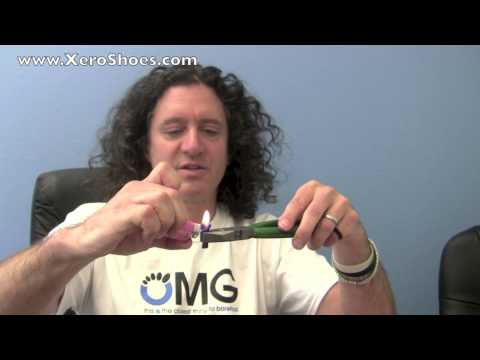
A lacing tip for your Xero Shoes
Here's a fun lacing tip/trick you can use with your Xero Shoes.Basically, it's making a "lacing loop" out of a small section of our new laces or using our toe loops.There are two reasons you may want to do this:1) It's a cool decorative element (especially if you use a different color for the loop than you do for the rest of your lacing), and lets you re-lace your Xero Shoes really fast.Here's what our sales manager, Rudy, did with this idea, when he added a loop at the ankle holes and toe hole:2) The other thing this lacing loop is good for is "addressing" a form problem.A very small number of people will create abrasion at the outside ankle hole which wears out the lace at that spot (FWIW, I and all the Xero wearers I know have put tens of thousands of miles on their shoes without ever wearing out a lace).If you do this, you can "fix" the problem, by attending to your gait (and stopping creating the extra horizontal friction that causes the problem).OR... you can "address" the problem by making the lace more resistant to abrasion. One way to do that is by rubbing some Shoe Goo on the lace. The lacing loop is another.The video below explains how to make the lacing loop and why you would use it.I can't wait to see what you do with this idea!

Woo-Hoo. Homer loves his Xero Shoes!
Woo-Hoo!Homer loves his Xero Shoes, too!;-)
The dumbest barefoot running study yet?
National Taiwan Normal University recently published a study in the journal, Gait & Posture, that might be the dumbest study ever done about barefoot running.Or, now that I think of it, it maybe it's the best.Hmmm...Let's start with the study and then I'll tell you why it's so stupid and so awesome at the same time.I don't need to bother with how the study was conducted and the typical problems with the study design, which are common to most of the barefoot running studies that have been done (too small a sample size, too homogeneous a sample size, not a good control group, lack of barefoot experience when barefoot experience is called for, etc. -- oh, I guess I did just bother :lol:).The important part is the conclusion:Habitually shod runners may be subject to injury more easily when they run barefoot and continue to use their heel strike pattern.Winner of the DUH! AwardFor those of you with some barefoot running experience under your belt, you'll immediately get the "this is a stupid study" idea.For those of you new to the barefoot thing, let me 'splain. In short, the one of the key philosophies behind running without shoes is that the typical heel-striking pattern that most people adopt when they put on running shoes, regardless of how much padding and motion stability is built into the shoes, is BAD FOR YOU.Adding the padding and motion control is attempting to address a problem that the shoe caused to begin with. It's like drilling a hole in a water pipe and then trying to patch it up with Silly Putty and saying, "See, it's fine!"Another philosophy of barefoot running is that it'll get you to stop heel-striking because, news flash, landing on your heel while barefoot HURTS.So, doing a study that says, "Running barefoot and heel-striking can be bad for you" is like doing a study that reveals, "Water is wet!"There isn't a barefoot runner on the planet who is surprised by these results.Winner of the AAAAWWWWESOOOOMMMMME AwardIronically, though, the obviousness of this study -- problems and all -- is what makes it one of the best studies about barefoot running yet.Why?Because it proves one of the core tenets of barefoot running!Okay, again, it doesn't unambiguously and completely prove it because of the limitations of the study. But by examining one of the simple ideas behind the barefoot movement and determining that all our anecdotal evidence has some scientific background, we can start to chip away at the nay-sayers who intone, "There are no studies that show that running barefoot is better for you."Ignoring the argument that there are no studies that show that SHOES are good for you, we now have a small study that backs up our claims.Winner of the That's What She Said! AwardOne other conclusion that came out of this study is that, perhaps, the advantages that barefoot running seems to provide come not from having your bare skin on the ground, but from the change in gait -- from heel-strike to, well, NOT heel-striking -- is where the real value comes from.That's the message that many of us -- including Chris McDougall, Daniel Lieberman, and Pete Larson -- have been saying. That is, "it's the form, not the footwear... but it happens that removing the footwear seems the best way to change the form... and it's FUN, feels great, and costs less."Hopefully we'll start seeing other studies that address some of the other simple claims of barefooters: Running barefoot naturally leads to a change in gait, without supplemental instruction That gait change, even in shoes, leads to fewer injuries That gait change, without shoes, leads to fewer injuries That gait change helps heal existing injuries ANYONE can run barefoot, pain-free and enjoyably. (Did I miss any?)
Barefoot Running Expert Daniel Lieberman on The Colbert Report
Most barefoot runners know Daniel Lieberman from Chris McDougall's best-seller, Born To Run.Dr. Lieberman is a professor of Evolutionary Biology at Harvard who has done some seminal research on barefoot running. One of his basic premises, from an evolutionary perspective, is that human's ability to sweat allowed us to run for long distances, letting us track down prey that overheats and tires out.While Dr. Lieberman is used to big deal academic situations, here he is on The Colbert Report.
Who wears running shoes... really?
It's no surprise that the vast majority of the people wearing Air Jordan's don't play basketball, that almost nobody who wears the Puma Faas shoes will give Usain Bolt a run for his money.Well, Saturday Night Live nailed it with this commercial for New Balance ;-)Like it? Then SHARE IT.
May the 4th be with you!
If you're going out on a run today, barefoot or otherwise...
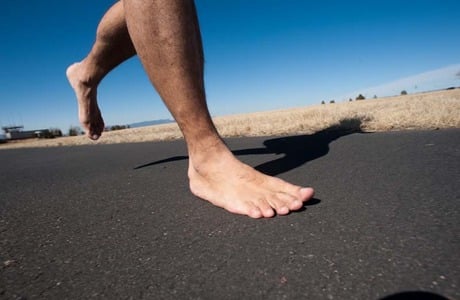
International Barefoot Running Day Donut Dash!
Join Xero Shoes for International Barefoot Running Day (IBRD) on Sunday, May 5th.IBRD is the brainchild of The Barefoot Runners Society, and the Colorado chapter has something special lined up:The 1st ever Barefoot Donut Dash! We'll start at 10am at the Xero Shoes office -- 5470 Conestoga Ct, Boulder, CO, 80301 -- with a barefoot running lesson. Whether you're brand new to barefoot, or haven't seen a pair of shoes in decades, you'll learn from and enjoy this simple class.Then, you can test your new (or improved) skills with either a 1k or 5k run/walk.Xero Shoes CEO and Masters All-American sprinter, Steven Sashen, will lead the 1k. Xero's Customer Service Manager and resident ultra-runner, Bill Babcock, will take people out on the 5k.Both runs will end about 75 meters from the Xero office... at Dizzy's Donuts, where you can get a gourmet doughnut (can you say, "Maple Bacon" or "Seriously Chocolate Cheesecake" or "Jalapeno Chedder"?!) at a special IBRD price.No experience is necessary.If you want to bring and wear minimalist shoes, that's okay (though you may learn that your minimalist shoes are getting in the way of learning to master barefoot running).Xero Shoes will also be on sale for IBRD participants.Please fill out this REGISTRATION FORM. If possible, scan/email it back to us at support@xeroshoes.live, or Fax it to 303.786.9292... or just bring it with you when you come to enjoy International Barefoot Running Day and the Donut Dash!
Does your barefoot running form look like this?
People always ask me for videos of barefoot running form.I usually avoid making them -- because the way *I* run is not necessarily the way *you* should run.That said, here's a video of Simon from Macedonia demonstrating what I think is some of the best barefoot form you'll ever see. I think everyone should be able to do this with a bit of practice. (NOT!)

Foot tattoos and barefoot sandals
On Facebook, Sarah asked:I'm getting the tops of my feet tattooed and need to find a way to tie them so that none of the laces touch the top of my feet! My big toe too! I figure a loop over my 2nd and 3rd toe....but anyone have tying suggestions for the heel?I said, "Well, that's a tricky one. A 'flip-flop' style will touch the top of your foot, and SOMETHING has to hold in on around your heel or it'll slip off..."But then I came up with the perfect answer. I'm going to use this tying style from now on!And, yes, this is an early April Fool's joke... there's no way you could actually run/walk with this... oh, wait, if I made the strap out of elastic... ;-)

Will Vibram Five Fingers or Running Barefoot Injure You?
From the "Here we go again" department of the barefoot running world:About once every 2 months, some major news publication chimes in with one of these two stories: "Barefoot Running is GREAT for you" or "Barefoot running is BAD for you."The latest is of the latter variety and comes with headlines like this one from the New York Times: Barefoot Running Can Cause Injuries, Too, and Runner's World's "Study: Vibram FiveFingers Lead To Greater Risk of Foot Bone Injury.!What are these seemingly anti-barefoot articles talking about?A study done at Brigham Young University took 36 "experienced, recreational runners" and had 19 of them "gradually transition to Vibram FiveFinger running shoes over 10 weeks."After 10 weeks, 10 of the 19 had increases in "bone marrow edema."The researchers concluded that "Runners interested in transitioning to minimalist running shoes, such as Vibram FiveFingers should transition very slowly and gradually in order to avoid potential stress injury in the foot."Okay, let the picking apart begin.Before I criticize the study, let me criticize the hyperbolic reporting about the study.It's as if any time someone suggests that barefoot running might be bad for you (we'll come to whether the suggestion is valid in a moment), reporters jump on the story with a "Nah-nee nah-nee boo-boo, stick your head in doo-doo!" attitude.Look at the NYT headline. "Barefoot Running Can Cause Injuries, Too."Why is this over-the-top? Well, I hate to point out the obvious, but this study did not examine barefoot running. It looked at some runners in Vibram FiveFingers.VFFs are NOT barefoot. They may look like feet (gorilla feet, sure, but feet nonetheless), but the amount of padding and stiff rubber they have causes most runners to have a different gait pattern when they're in VFFs versus when they are barefoot. Simply, things that hurt when barefoot (e.g. over striding or landing too stiffly) are often unnoticed when in VFFs.The Runner's World headline, while accurate (it is reporting the conclusion of the researchers), it's a bit histrionic. That is, it almost implies agreement with the study. Had the reporter chosen to evaluate the study, rather than simply giving "just the facts, ma'am," or brought in an opinion from someone who evaluated the study, the headline might have been very different with a less anti-barefoot flavor.Now, don't get me wrong. Even though I'm a true believer in barefoot running (and walking and hiking and camping and kayaking and almost everything else), I'm also scientifically minded. If there were a good study that showed, "Barefoot running will erase photos from your hard drive!" I'd be the first to tell you to get a backup drive and buy some shoes.But this wasn't a good study.Let's break down the "barefoot" running study this way at first to see why:1) The researchers had the runners transition to VFFs by following a protocol from the Vibram website.2) A significant portion of those runners developed bone edema over 10 weeks.3) The researchers equated a certain amount of bone edema with injuryBased on this information, it's just as reasonable to conclude that the VFF transition program is the cause of injury, not the VFFs themselves.Next, if you poke around the podiatry and sports medicine world, you find another problem, namely, that there's a debate about the meaning of bone edema. Does bone edema = injury? The jury is out.So those two points alone should make you question what the study really shows.One thing we know it shows is that a majority of the VFF wearers got bone edema. And let's for now, assume that's the same as getting injured.In fact, let's dig a little deeper to find out that 2 of the VFF wearers got actual stress fractures -- definite injuries.Why did the runners get injured?Let's dig even deeper and look at those stress fractures.One was in the heel. How would you get that? Most likely by heel striking, a big no-no in the barefoot world and the common way to run in running shoes.The other was in the 2nd metatarsal? How would you get that? By landing hard on that bone behind your 2nd toe. And how does one do that? In my experience, by thinking "I'm supposed to land on the ball of my foot" and reaching out with your foot to do so. In other words, by over striding… the second big barefoot no-no.In other words, what this study may have really shown is that people who switch to VFFs who don't change their running form, or who change it incorrectly, get injured.But we have no way to know if that's what happened because the researchers didn't evaluate form. They didn't check to see if form changed over time.(BTW, the American Council on Exercise *did* look into that and found that most VFF runners do not change their form compared to how they ran in running shoes. Pete Larson took videos at the 2011 New York Barefoot Run and found the same thing -- most VFF runners were still heel striking as if they were in regular running shoes. Again, my explanation is that the VFFs don't give you enough feedback -- admittedly, discomfort -- to inspire the change.)The important barefoot running messageMost of us in the barefoot world like to say, "It's not the footwear, it's the form… it's just that some minimalist footwear helps you change your form better than others."What helps you change your form is feedback from the ground, the sensations you get when you run barefoot on a hard surface. In short, if it hurts, you'll try something different so that it doesn't, especially if you get a few tips about what to try (e.g. how to not overstride, how to not pull/push the ground, how to lift your feet off the ground rather than pushing).As far as getting sensations goes, barefoot is best. Xero Shoes are a close second (it's as if you're totally barefoot, but someone threw a thin layer of flexible rubber on the ground).Where are VFFs? Well, it depends on which ones you wear! Some have more padding (i.e. reduce ground feel) more than others. And in this study, we don't know which ones the runners were wearing.Let's back up a bit to another odd fact from the study. The shod runners averaged 30 miles/week, but the VFF runners averaged 15-18 miles/week. That's a BIG difference. And when you look at the transition plan, following the plan doesn't account for running half the mileage of your shoe wearing compatriots.Dr. Ridge guessed that the runners cut their mileage "because their feet hurt" but there's no indication that they ever reported pain, and since 9 out of 9 runners had no edema, they should have been still running their usual 30/week mileage, which would mean the 10 "injured" runners must have cut their mileage to about ZERO to get an average of 15-18.I suspect that the "random assignment" of people into the VFF group accidentally put the less skillful and accomplished runners into VFFs. I don't know for sure, because I don't see any stats on the pre-study mileage of each runner compared to the in-study mileage, let alone how the mileage changed for the "bone edema runners" vs. the "non-edema runners."Finally, let's look at the conclusion the researchers came to:Runners interested in transitioning to barefoot running shoes, such as Vibram FiveFingers should transition very slowly and gradually in order to avoid potential stress injury in the foot.Uh… how did they come to that conclusion?They didn't compare runners who transitioned in 4 weeks, 8 weeks, 10 weeks, or 10 years. For all we know, transitioning more slowly could be WORSE for you. Their suggestion might be as useless as, "If you want to avoid the frustration of learning Spanish, transition slowly and learn one new word per week."In other words, they have no basis to make that conclusion.The transition to barefoot running that I recommend starts with MUCH less distance than the VFF plan… but with more frequency (a little bit, more often). And it increases distance and frequency based on your unique experience, not some arbitrary schedule.Once again, I'm left with the hope for more, and more nuanced and well-designed, barefoot running studies. And, even more, for more and more nuanced reporting about barefoot running (or, in this case, minimalist running).The content of this post does not constitute and is not intended to be a substitute for professional medical advice, diagnosis or treatment. Always seek the advice of a physician or other qualified health provider with any questions or concerns you may have about your health or a medical condition.






