The Xero Blog

A person tying their Pacer Lite Xero Shoes shoe laces

What to Look for in Barefoot Walking Shoes

Say you’ve heard all the benefits of walking in barefoot shoes and you’re ready to make the jump. Make sure you know what to look for when shopping. The best barefoot shoes for walking have a wide, foot-shaped toe box, a thin and flexible sole, and a zero-drop design that keeps your heel and forefoot level. Just as important is fit: your toes should have room to spread while your heel and midfoot stay secure. There is so much guidance on finding the right running shoes, but walking has different needs. For one, most people land heel first when they walk, and some days you might be climbing hills or carrying a weighted vest. Here’s what to look for, with advice from a podiatrist, a chiropractor and the designer behind our new walking shoe. Are Barefoot Shoes Good for Walking? “Barefoot shoes can be great for walking,” says Dr. Alissa Kuizinas, DPM of Wellness in Motion. “They allow the foot to utilize the full range of motion of the joints, and to use all of the lower extremity muscles fluidly. They also allow great feedback from the ground.” However, barefoot shoes may not be an instant fit for everyone. Dr. Kuizinas notes that people with limited joint mobility, current injuries or significant stiffness may need more time, and that soft surfaces are easier to start on than pavement. Barefoot vs. Zero Drop Shoes Going completely barefoot isn't for everyone and isn't right for every occasion.  The good news is that you can walk in barefoot (or minimalist) shoes instead. That's why we created Xero Shoes - so you feel the benefits of being barefoot while still protecting your feet.  Barefoot shoes are designed to feel like you’re barefoot with a foot-shaped design and minimal cushioning, but you get a balance of ground-feel and much-needed protection. People often use barefoot and zero-drop shoes interchangeably, which isn’t accurate, since you can have a zero-drop shoe with a stiff, or highly cushioned sole. Zero-drop shoes are characterized as flat from heel to toe.  When it comes to walking, Dr. Matt Driscoll, DC of Driscoll Chiropractic, says that a zero-drop design creates a more balanced relationship between the muscles on the front of the lower leg (the shin muscles) and those on the back (the calves). “This allows muscles to regain their optimal length and strength, improving their ability to absorb force efficiently and enhance movement.” The Barefoot Shoe Checklist  The characteristics of a truly “barefoot shoe” are: Foot-shaped toe box Zero-drop, flat from heel to toe Flexible sole that bends and flexes with your feet Thin sole with minimal cushioning for ground feel No arch support Lightweight .     Two Tests You Can Do at Home Toe Box Test: Take out the insole and stand on it. If your foot spills past the edges, the shoe is too narrow. Dr. Kuizinas says “your toes should sit comfortably without scrunching.” Flex Test: Bend the shoe toe to heel, then twist it. It should move easily in your hands. Xero Shoes checks all the “barefoot boxes.” But it’s not just about the design, it’s how you wear the shoes. Once you decide how you’ll wear barefoot shoes, like for workouts, hiking or casual wear, you’ll find more activity-specific features.  What to Look for in Barefoot Walking Shoes There are a few specifics that you’ll want to look for as you pick out barefoot walking shoes.  Dr. Kuizinas says the features that matter most for walking shoes are the fit, cushion level, and structure of the shoe. Walkers want to find the shoe that matches their specific foot needs. Fit When you’re walking, having room for the toes to spread out helps power the push off as you move through your stride. Having wide shoes or wide feet is different than a wide toe box. It’s important that the design is foot-shaped where the toe box is wide but the heel and midfoot are held securely in place, instead of wide throughout the entire shoe.  Width isn’t the only thing that matters, consider depth too: if you have larger toes or toes that curl, you may need a taller toe box Sole Thickness “Ideal thickness of the sole really depends on the person,” says Dr. Kuizinas. “For some people a thinner sole is great because it allows for excellent ground feel and feedback and improves stability and balance. For others, thicker soles can be helpful to attenuate shock.” That’s the thinking behind the Pacer Lite: it’s a walking shoe that still has a thin, flexible 13.5mm sole for ground feel, but added protection with a heel crash pad right where walkers land. Flexibility Your feet are meant to bend and flex naturally throughout your walking gait, so that’s why sole flexibility is so important for everyday walking. Walking shoes with a flexible sole that can bend easily promotes natural movement through the foot's range of motion.  Upper and Breathability If you’re logging your 10,000 steps, you may spend longer in walking shoes than in a pair you wear for a quick run. You’ll want a shoe with a breathable upper to keep feet cool on long miles. The Pacer Lite’s flexible upper features breathable engineered mesh. Traction Look for tread where your foot actually meets the ground: under the heel, where you land, and under the ball of the foot and big toe, where you push off. The more varied your walks (pavement, park paths, hills), the more traction matters. Does a Walking Shoe Need Anything Different? Yes. Walking loads your foot differently than running. You land heel first more often, and one foot is always on the ground. “Barefoot shoes will require you to use your full range of motion of the joints in your lower body,” Dr. Kuizinas says. “Features such as cushioning level, added stability components, and heel-toe drop will affect peak pressures on joints and how much muscle force is required with each step.” When you look into the technical design of creating a barefoot walking shoe, there is much more that goes into it than you think.  The design team mapped four ways people use walking shoes, from most to least common: walking, fast walking, hilling (walking uphill), and rucking (walking with a weighted vest or pack).  Walking uphill shifts weight to the ball of your foot and toes, so a flexible forefoot allows for natural motion. You also need traction under the forefoot so you don’t slip. Rucking adds weight to every step, putting more pressure on your heel and the ball of your foot. That’s where an outsole needs extra durability. Sizing You may have learned that you need a certain amount of space between your toes and the front of your shoes. That’s because most shoes taper inward and squeeze your toes, so you’re adding a thumb’s width or more to make your toes feel more comfortable. With barefoot shoes, you may not have to size up, especially if you have a narrower foot. Your toes will still have room to spread, but your shoes will feel secure as you’re walking. Learn more about sizing your Xero Shoes.  When shopping for barefoot walking shoes, prioritize a foot-shaped toe box, a thin and flexible sole, and a zero-drop design. Then look for features made for how you walk. That’s exactly what we built the Pacer Lite to do.  FAQs How much room should a barefoot shoe’s toe box have? Dr. Kuizinas says to look for a wider, foot-shaped toe box that allows your toes to spread. You may also want to look for a taller toe box depth, particularly if you feel you need more room above your toes. How thick should a walking shoe’s sole be? A thinner sole gives you better ground feel and feedback. But Dr. Kuizinas notes that for some people, “thicker soles can be helpful to attenuate shock and reduce overall loading of the feet with each step.” It depends on your foot strength, flexibility and how used to barefoot shoes you are. Can you wear other barefoot shoes for walking? Yes, most barefoot shoes have the same features like a wide toe box, zero-drop flexible sole, and minimal cushioning, you’ll get ground feedback and natural comfort. The Pacer Lite barefoot walking shoe, has a walk-specific outsole that was designed for the walking gait, featuring a small layer of foam in the heel to absorb the impact from heel striking, which is common in walking.   Are barefoot shoes good for rucking or walking with a weighted vest?  Since rucking adds more load to your steps, barefoot shoes can be a good step up once your feet are adjusted. Adding weight increases the load on your feet, so build up to it gradually. The Pacer Lite’s outsole was designed with rucking in mind, with larger lugs at the heel and ball of the foot, where weighted walking puts the most pressure. As Dr. Driscoll says, the key is to transition gradually, listen to your body, and allow sufficient time for adaptation. More info on transitioning to barefoot shoes. The content of this post is for educational and informational purposes only and does not constitute and is not intended to be a substitute for professional medical advice, diagnosis or treatment. Always seek the advice of a physician or other qualified health provider with any questions or concerns you may have about your health or a medical condition.  About the Expert:  Dr. Alissa Kuizinas Dr. Kuizinas, DPM, is a board certified podiatrist who's passionate about foot health. She loves seeing patients transform their feet without surgery or invasive procedures. She is based in Boston, where she sees patients virtually and in-person at her practice, Wellness in Motion. 
Read More What to Look for in Barefoot Walking Shoes
Max-Cushion vs. Barefoot Shoes: It’s not All or Nothing

Max-Cushion vs. Barefoot Shoes: It’s not All or Nothing

Look around the gym, the jogging paths, or the coffee line, and you'll notice a lot of shoe between most people’s feet and the ground. Max-cushion shoes, with their thick stacks of soft foam, are everywhere. A recent Wall Street Journal article interviewed podiatrists, sports-medicine doctors, and coaches about how cushioning changes the way we move.  So is more cushion bad? Not exactly. Cushioning is a trade-off: it can feel great, but it changes how much your feet feel and do with every step. Their advice wasn’t to go all-in on cushioning or minimal. It was to mix up your footwear, rotating between shoes with different cushioning and stack heights.  What are max-cushion shoes? Max-cushion shoes have a thick layer of foam between your foot and the ground. According to the WSJ article, some carry close to two inches of it.  This could add stack height and heel-to-toe drop. Stack height is the thickness of the sole and how far your foot sits above the ground. Heel-to-toe drop is how much higher your heel sits than your toes.  Xero Shoes and true barefoot shoes are always zero-drop, so the heel to toe are the same level, and typically close to the ground. Today it's hard to find a running or walking shoe that isn't sitting on a platform of foam. We think there’s a good case for adding barefoot shoes to your shoe closet. What changes with more cushioning? Thick foam changes two things: how much information your feet get from the ground, and how much they have to work to keep you steady. Ground feel. Your feet have thousands of nerve endings that provide feedback to the rest of your body.  Dr. Ray McClanahan, DPM, podiatrist at NW Foot & Ankle and inventor of Correct Toes says that feedback plays a big role in how well we move. “Thick shoes can blunt sensory information and hamper human movement.” Stability. Think about standing on a pillow. Your foot sinks into the soft surface and has to work harder to balance. Stack another pillow and it may be even harder to balance. You may notice your feet wobble side to side and your ankles and knees may quiver.  Now just stand barefoot on the ground. Notice how the direct contact to the ground feels. You may see your toes spread out. Do you feel more stable? Curious how footwear plays into balance? Here's what one study found about minimal shoes and balance. Impact. You might expect more foam to soften every landing, but a 2018 study in Scientific Reports found the opposite. Researchers had 12 runners try both a max-cushion shoe and a conventional running shoe. In the max-cushion pair, their legs stiffened more on landing and the initial impact force was higher, especially at faster speeds. The researchers think the body may brace against soft foam, much the way it does when running on a softer surface. The study was small and looked at running, not walking, but it's a good reminder that more cushion may not soften the impact. Learn more about just what happens when you take a step. Thin, flexible soles are core to every Xero Shoes design: they protect your feet while letting you feel the ground. What can the barefoot running boom teach us? In the late 2000s, the bestselling book Born to Run sparked a barefoot running craze. Lots of people traded their cushioned shoes for barefoot shoes overnight. That led to some backlash, because many people's feet never got the chance to adjust. It was too much change, too fast. Dr. McClanahan has worked with athletes for 31 years. He recommends controlled barefoot training to the athletes he treats. His advice for everyone else: "Our feet and bodies are capable of so much more than most people realize. If you want to learn what you are really capable of, pay careful attention to what you put on your feet, and your body will thank you for years to come." Xero Shoes' advice: go slow and let your feet adapt as you transition to barefoot shoes. How to add barefoot shoes to your rotation You don't have to throw out all your cushioned shoes. If anything, the experts interviewed in WSJ recommend rotating shoes with different amounts of cushioning and stack height, and introducing any new style very gradually. We like to call it microdosing. Here's a simple way to start: Week 1: Wear barefoot shoes for 2-3 short walks or errands. Week 2: Add 5 minutes to your walks or an extra errand. Weeks 3 and 4: Wear them every other day and go a little longer each time. After that: Work them into everyday wear. If you’re eager to run in barefoot shoes, it’s best to ease gradually. Dr. McClanahan says that people who suddenly switch to barefoot style shoes when they haven't properly trained their bodies to do so safely is what tends to get people in trouble. He recommends a slow progressive transition. “... for those new to barefoot shoes, it can take months to years to accomplish without injury.” Listen to your feet as you go. Tight calves or tired feet are common as they adapt, so slow down if you need to.  FAQ What is stack height in shoes? Stack height is the thickness of a shoe's sole, or how far your foot sits above the ground. Max-cushion shoes have a high stack height. Barefoot-inspired shoes have a low one, often just a few millimeters, so you can feel the ground beneath you. Are zero-drop shoes the same as barefoot shoes? Not always. Zero-drop means your heel and toes sit at the same height. A shoe can be zero-drop and still heavily cushioned. Barefoot-inspired shoes are zero-drop and also have a thin, flexible sole and a wide toe box that lets your toes spread. Can I wear barefoot shoes and cushioned shoes in the same week? Yes, and it's a great way to start. Rotating between different types of shoes gives your feet a variety of experiences. Start with short sessions in barefoot-inspired shoes, like a walk or an errand, and add more time as your feet adapt. How long does it take to get used to barefoot shoes? It varies from person to person. Some people feel at home within a few weeks of everyday walking, while others take several months, especially before running. Start small, pay attention to how your calves and feet feel, and increase your time gradually. Learn more about transitioning to barefoot shoes. The bottom line: rotate your shoes You don’t have to make the choice for max cushion or barefoot. Different shoes change how your feet feel and move. Many experts agree: different shoes introduced slowly, beats an overnight switch in either direction. The content of this post is for educational and informational purposes only and does not constitute and is not intended to be a substitute for professional medical advice, diagnosis or treatment. Always seek the advice of a physician or other qualified health provider with any questions or concerns you may have about your health or a medical condition. 
Read More Max-Cushion vs. Barefoot Shoes: It’s not All or Nothing
Can Your Shoes Affect Your Balance? What a Year-Long Study Found

Can Your Shoes Affect Your Balance? What a Year-Long Study Found

Try this: stand on one foot. Now close your eyes and start counting. If you started wobbling before you hit 10, you're not alone. It doesn’t matter whether you're 35 or 75, balance is one of those skills you don't think about until it slips. The good news: it's trainable at any age, and a 2025 randomized control trial published in Gerontology suggests something as simple as your shoes may play a bigger role than most of us realized. Why Does Balance Matter At Every Age? Balance is one of the ways your body’s systems work together. Every time you stand, walk or change direction, your brain blends three streams of information: what your eyes see, what your inner ear senses, and what your feet and joints report about where you are in space (that’s proprioception). Your body makes constant, tiny corrections to keep you upright. When balance starts to slip, it's often an early sign that one of those systems is getting less practice. Balance is a use-it-or-lose-it skill, so the habits you build in your 30s and 40s are the ones you'll be standing on later. According to the Centers for Disease Control, falls remain one of the leading causes of injury and death in older adults (ages 65+). A 2022 study in British Journal of Sports Medicine ­­­­­­­­suggests that older adults (ages 51-75) who struggled to stand on one leg for 10 seconds had nearly twice the risk of premature death than people who reached the 10-second mark. How Do Your Feet Affect Your Balance? Your feet are the only part of your body actually touching the ground. Each foot is estimated to have more than 200,000 nerve endings, so direct contact with the ground is the best way to take in sensory information. To be clear, you need shoes to protect your feet. But you can pick a pair that works with your body and has as little between your feet and the ground. 2018 research published in Maturitis suggests that foot problems, such as weak foot muscles, foot pain, pronation, or even hammer toes, could be a risk factor for falls in older adults.  What Did the Study on Minimalist Shoes Find About Balance in Older Adults? Now back to the study: “Effects of Long-Term Minimal Footwear Use on Fall-Risk and Fall Incidence in Older Adults”. The study followed 65 older adults (65+) with established fall risk for a full year.  The results showed improvements in balance for older adults (65+) who wore minimal shoes, compared to those who simply did range-of-motion exercises.  What participants did. The footwear group wore minimal shoes (the Xero Shoes Aptos), starting with 30 minutes of walking a day, either all at once or for shorter periods. Over time they wore the shoes for more of their daily life, building up to 7 to 8 hours a day.  The control group did seated upper- and lower-body range-of-motion exercises that left out the toes, feet and ankles. How balance was measured. Tests included sit-to-stand, one-legged balance, and standing on a firm or softer surface with eyes open or closed. What they found. The minimal-shoe group showed significant, sustained improvements in balance at 16 weeks and again at one year. The control group showed essentially no change. Even if you’re not an older adult or at risk with balance, the participants in the study improved their balance just by simple daily changes. You can practice balance at any age. What Makes A Good Shoe for Balance? The results of the study suggest that wearing minimal footwear, and slowly adapting to wear in your daily life, could improve dynamic balance. But just how do your shoes play such an important role?  The study defined minimal footwear as shoes that are thin, flexible enough to fold in half, and have a wide toe box. The authors suggest these features may give your feet a wider base, more sensory feedback, and more room for the small muscles inside your feet to do their job. The Aptos used in the study has since been discontinued, but every pair of Xero Shoes is built around the same barefoot features: Flexible: Thin, flexible soles let your feet bend and feel the ground  Wider Toe Box: A foot-shaped design gives your toes space to splay  Zero-Drop: The shoes are flat from heel to toes  We like to think the best shoes are those that you don’t even realize you’re wearing.’ Everyday Ways to Practice Balance Simply standing on one foot is one of the easiest ways to practice balance. It’s also another indicator of longevity, as mentioned in the earlier 2022 study in British Journal of Sports Medicine. It’s easy to incorporate one-legged balancing into your everyday life, and it’s never too early to start.  Practice standing on one leg while: Brushing your teeth Standing in line Cooking dinner on the stove Waiting for your coffee to brew During a meeting or phone call Start by standing next to a counter or wall to hold onto for added support then progress to standing without support. Challenge yourself: Close your eyes Stand on your non-dominant foot Pin your arms to your sides so you don’t have counter-balance Don’t hop on the standing foot  Stand on an unstable surface like a foam pad, pillow or BOSU balance trainer Say you’re an athlete and already doing sport-specific training. Single-leg moves like split squats, step-downs and single-leg deadlifts put the same skill to work under load. How to Start Wearing Minimal Shoes Do what the study participants did: start small. Just walking in minimalist shoes is a good first step. The participants walked in minimalist shoes for 30 minutes daily, and slowly incorporated wearing them daily throughout the course of a year. And if you need more guidance, learn more about transitioning to barefoot shoes. Want to strengthen your feet and discover other simple exercises that could unlock better balance? Check out these foot core exercises. For anyone thinking seriously about longevity: the next frontier of healthy aging may not require a new supplement or biohack. It might be reconsidering something as basic as what’s on your feet. Shoe Picks Slip Ons:  Dillon Canvas Slip-On Pagosa collection Prio Coast Coast Suede Xero Shoes’ Most Minimal Styles:  Genesis (5mm) Speed Force II (6mm) Cassie Knit (6.5mm) Z-Trek (7mm) FAQs Did the Gerontology study show any correlation to minimalist shoes and falls?  Falls trended in the minimal-shoe group's favor: about 77% stayed completely fall-free over the year, compared with 52% of the control group. But that difference wasn't statistically significant, so the study doesn't show whether minimal shoes affect how often people fall. Where do I find the Xero Shoes used in the study? Xero Shoes’ Aptos shoe was used in the study, and the shoe is discontinued. The Dillon Canvas Slip-On is a close design to the Aptos, featuring a slip-on design. I’m young, when do I really need to start working on my balance? Building a habit early is never a bad thing. If you’re an athlete, chances are you’re already doing balancing drills without realizing it. Incorporate one-legged balances or weight exercises into your routine to challenge yourself. Are all zero-drop shoes minimal? No. Zero-drop only means a shoe is flat from heel to toe, and some zero-drop shoes still have thick cushioning. The study tested minimal shoes: thin, flexible enough to fold in half, with a wide toe box. Learn more about zero-drop shoes. Should I check with a doctor before switching?  If you have concerns about your balance or your health, talk to your doctor before changing your footwear or routine. Either way, transition gradually. The content of this post is for educational and informational purposes only and does not constitute and is not intended to be a substitute for professional medical advice, diagnosis or treatment. Always seek the advice of a physician or other qualified health provider with any questions or concerns you may have about your health or a medical condition.   
Read More Can Your Shoes Affect Your Balance? What a Year-Long Study Found

latest News

The World's Fastest Triathlon

The World's Fastest Triathlon

I just did the world's fastest triathlon. A TRUE sprint triathlon.That was #mytri.Share this and let's get more people doing THEIR triathlons.Now let me see yours!

Watch GOSHEN for FREE here

Watch GOSHEN for FREE here

The filmmakers of GOSHEN, an award winning documentary highlighting the benefits of the Tarahumara running tribe's "barefoot sandals" are offering FREE VIEWING of the full film for two days only -- Saturday and Sunday, October 10-11.Watch GOSHEN here, or rent it for free for Saturday/Sunday by going to www.GoshenFilm.com/buy-dvd.html and use the coupon code GOSHENXERO. Remember this free offer is only valid on October 10-11, 2015.(The preview will show, below, until Saturday, when the ACTUAL film will be available.)GET THE DVD TODAY!

Bernard Lagat Won't Run Barefoot?

Bernard Lagat Won't Run Barefoot?

This just in from the "WHAT A SHOCK... NOT" category:Runner who gets paid millions from shoe company says he won't run barefoot!In an interview with The Guardian, Bernard Lagat, the Kenyan-American 13-time medal winning middle- and long-distance runner, is asked by Kate Carter:So, um, ever run barefoot?Bernard's response:[Laughs] Well, since I came to the developed world I’ve never run barefoot and I always say there’s no way on earth I am ever going to run barefoot. I did a good 15 years or so of barefoot running, walking. Now I see the shoes and I’m like, “That’s my best friend for life!” Never since I crossed the big pond! My shoes will always be on my feet for ever.Now let me see if I get this straight. A guy who gets paid millions from his shoe company sponsor will never go barefoot again.Let's say the guy really does simply love his shoes. Here's the question that Kate should have asked as a follow up:Bernard, do you think that 15 years of running barefoot helped you in some way, like improving your form and eliminating overstriding, or strengthening your feet and legs, or teaching you to adjust your gait and cadence, or improving your reflexes or sensorimotor skill? And please answer as if whatever you say will not be read by the shoe company that has helped make you a millionaire.Frankly, I couldn't care less what Bernard thinks or believes about running barefoot. The guy is one of the best middle- and long-distance runners ever. By definition that makes him a freak, an outlier.I'm not sure that a 5'8" guy who weighs 134 pounds and runs 1500 meters (just shy of a mile) in 3 minutes, 26 seconds, is someone whose experience extrapolates to normal humans.Be that as it may, what really gets to me is the headline:Bernard Lagat: 'There’s no way on earth I am ever going to run barefoot again!'Out of all the interesting and provocative and useful things Bernard said, I'm sort of dumbstruck why this became the headline. It's not like the world is FULL of barefoot runners who will be impacted by Bernard's thoughts. There aren't even a gaggle of runners on the fence about running barefoot who will see the headline and think, "Thank God I know Bernard won't run barefoot; now I don't have to either!"It's a headline that is only attention-grabbing to a small number of humans. So why all the fuss?I'm sure it had nothing to do with Bernard being sponsored by a shoe company that makes money every time some runners sees him in their shoes, and who is featured in the photograph at the top of the article (shown below so you know who it is).
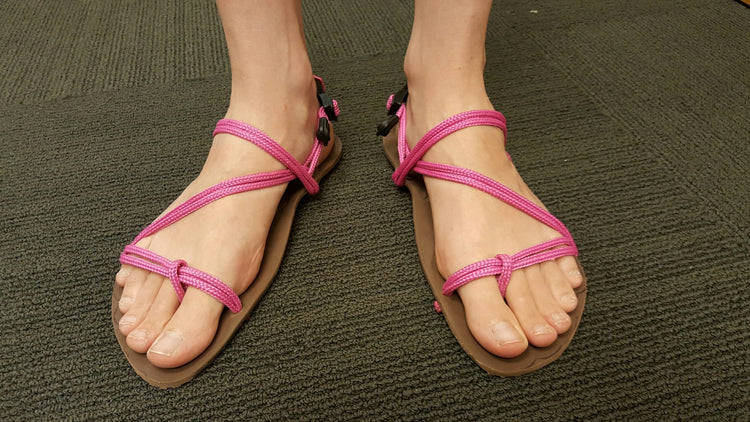
Make your own Sandals - DIY huaraches

Make your own sandals, Janice style ;-)

Our Customer Happiness Manager, Janice, has been on a roll, creating new DIY sandal designs.This latest was inspired by our Z-Trek sandals. It uses the "loop" idea from this sandal, and the Heel Strap from our Amuri sandals.Remember, when you make a kit that has laces touching the ground (like the outside edge by her pinky toes), you'll want to protect them from abrasion. We recommend using Shoe Goo.
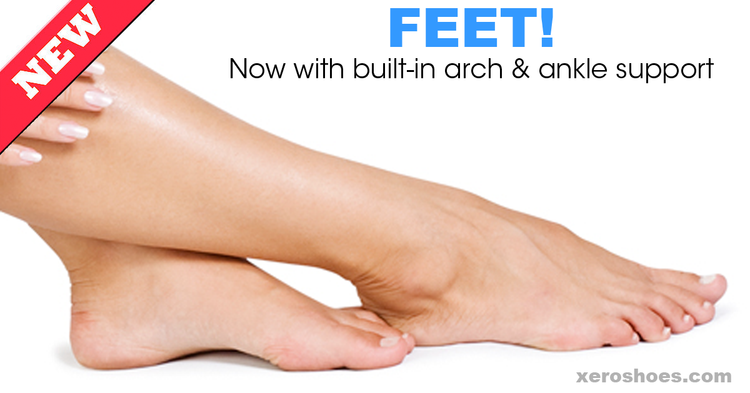
Feet With Built In Support

New Technology in Ankle support, Arch support, Flat Feet and High Arches

Do you need arch support?Ankle support?If so, try the newest product on the market today, YOUR FEET!New and improved for 2022 with built-in arch support and ankle support!You've tried everything else — shoes, orthotics, inserts — now try YOUR FEET!Their flexible construction with almost 1/4 of all the bones and joints in your body, and clever 5-pronged design, allow for balance, propulsion, gripping, and much, much more.Plus, they look pretty cool, too!The articulated connection to the lower leg (sold separately) keeps you upright and moving, even as you traverse uneven terrain (yes, they're perfect for hiking, no boots required)!With continued use, YOUR FEET! will take you wherever you want to go, with confidence, grace, and strength.Maintaining YOUR FEET! is simple and only requires soap and water. But for a unique experience, you may try one of the many FEET! outlets that provide decorative accessories and check your Yellow Pages for "Pedicure".Try YOUR FEET! today.Check out the bottom of YOUR LEGS! to get yours.(oh, and for the times where YOUR FEET! need a bit of protection and some extra style, try Xero Shoes, too...) 

Stand Up Paddle Board with Xero Shoes

Stand Up Paddle Boarding Sandals

Some people love the feeling of sand between their toes.Others. Not so much.Same thing with stand up paddle boarding. Some love to SUP bare footed. Others want a bit of protection, especially if they're somewhere that they have to jump off onto a less-than-ideal surface (think coral, or rocks, or ewwy-gooey things ;-) ).We've heard from Xero Shoes customers who wear their sandals on their boards. Others just use them to get to and from the water (stick 'em in your pocket when you're on the board).Similarly, we've got a bunch of sea kayakers, canoeists, and rafters who've taken their Xeros on some pretty sweet water.You, too?Send us your photos and let's see.

Sandals for Barefoot Running? KWGN Investigates.

Sandals for Barefoot Running? KWGN Investigates.

Vicky Evans from KWGN came out to our new office to check out Xero Shoes.What did she think? Watch the video and find out... While Vicky emphasized barefoot running, people enjoy Xero Shoes for, well, anything you can imagine doing in a sandal... and things you would NEVER do in a flip flop: A walk on the beach A hike in the woods A workout in the gym Keeping that "grounded" feeling you get after a yoga class Paddle boarding Approaching a climb We've even had people run 100+ mile ultramarathons in Xero Shoes!Check 'em out here

GOSHEN Movie Trailer - Watch it here!

GOSHEN Movie Trailer - Watch it here!

As many of you know, Xero Shoes were inspired by the Tarahumara of Mexico. First, we were inspired by their story of running enjoyably and injury-free into their 70s and beyond.Then we were inspired by the fact that they ran barefoot or in huaraches -- sandals they made out of scraps of tire and leather.The Tarahumara are also facing serious challenges. A long-running drought, problems with local drug cartels, inaccessibility, medical problems.For all of these reasons, we support the Tarahumara with a percentage of the sales of our custom-made Xero Shoes.And to further support the Tarahumara, we're thrilled to share the documentary GOSHEN with you. Filmmakers Dana Richardson and Sarah Zentz's movie, GOSHEN, reveals how the Tarahumara tribe's ancient diet and active lifestyle could not only transform your personal health and fitness, but may be the key to preserving Tarahumara culture as well.Watch the trailer, below. Own the GOSHEN DVD Today!

TrailMax Ultra Running Sandal

TrailMax Ultra Running Sandal

Introducing the new TrailMax running sandal.The USA-made sports sandal ingeniously combines the benefits of zero-drop, barefoot footwear with jaw-dropping 65 mm (5.26 inch) of dense, anti-memory foam rubber in the sole for maximum cushioning support.The TrailMax weighs less than the Hoka but boasts more than twice the stack height. According to Boulder-based TrailMax’s creator and company president and retired orthopedist, Dr. C.U. Canyon, “This shoe was specifically developed for ultra runners who want even much more soft, springy support for all the wear and tear on their legs that running on rocky or uneven terrain for hours on end produces."The TrailMax eliminates muscle use and natural foot movement," says Canyon. "Less exhaustion means more miles... way more than you should run otherwise." One warning Canyon offers, "If you step on a pea, you'll really feel it."The TrailMax sells for $499 and will be available online April 1 and at select specialty running stores.

Paleo Diet + Barefoot Running = ?

Paleo Diet + Barefoot Running = ?

Are you on the Paleo diet, or curious about it?Many people who discover paleo -- and I'm neither endorsing it or bashing it in this article -- move past the diet and into the "lifestyle," looking to move and live more like our hominid ancestors. And, not surprisingly, one way to recapture our movement history is by running in bare feet.Neanderthals didn't wear Nike and you don't need to either.All that said, I had the privilege of getting interviewed by Aaron Olson of www.paleorunner.orgCheck it out here, then let me know what you think in the comments, below...What do we talk about? Are sore calves and Achilles necessary when learning to run barefoot? Will Xero Shoes protect you if you're trail running? Why doctors who criticize barefoot running are usually complete morons! Are there any times where you need shoes? Can you run fast in huarache running sandals? What it's like to be on Shark Tank Why you need to USE your feet the way they're made to be used Do I eat Paleo? What do I eat? Enjoy!The content of this post does not constitute and is not intended to be a substitute for professional medical advice, diagnosis or treatment. Always seek the advice of a physician or other qualified health provider with any questions or concerns you may have about your health or a medical condition.

Run faster and stronger with the Exer-Genie

Run faster and stronger with the Exer-Genie

I know, I know... "Exer-genie" sounds like the name of a fitness gadget that women in the 1950's would have used.But don't let the name fool you. This is one serious piece of equipment, all rolled up into a tiny, travel-friendly, package that anyone of any fitness level can use to get stronger and faster.The Exer-Genie has been used by Olympians and professional sports teams for decades. And, frankly, given what a gadget geek that I am (especially fitness gadgets), I can't  believe that I only recently discovered it.Let me show you a quick video of how my training partner, World-champion sprinter Cathy Nicoletti, and I now use the Exer-Genie as part of our sprinting training.In short: we'll do resisted runs with enough resistance to slow us down no more than 10%, usually increasing the resistance with each run, and then finish with a non-resisted run.We're planning to integrate more heavy-resistance running (for improved drive phase performance), as well as resisted walking lunges and bounding. Sometimes we'll use the Exer-Genie at the end of a speed workout. Other times we do an entire workout with the Exer-Genie.There are essentially 2 models of the ExerGenie that you'll be interested in: The Classic system with a shorter rope for strength training (you can practically replace a gym's worth equipment with this), or the long-rope Speed system for doing resisted running (and jumping, bounding, lunging, etc.). If you're into suspension training, like with a TRX, you'll want to look at the Dynamic Life system as well... a variation of the short rope system.The folks at ExerGenie are INCREDIBLY helpful and committed to your fitness. If you have any questions, just give them a call (number is at the website). Tell 'em we said Hi! Find out more about the Exer-Genie here.The content of this post does not constitute and is not intended to be a substitute for professional medical advice, diagnosis or treatment. Always seek the advice of a physician or other qualified health provider with any questions or concerns you may have about your health or a medical condition.
Mindful Running with Michael Sandler

Mindful Running with Michael Sandler

Some readers may know that Michael Sandler is one of the reasons Xero Shoes exists.Back in the Summer of 2009 he said, "You know, if you treated this hobby of making barefoot sandals like a business -- and built a website -- I'd put you in a book that I'm writing called Barefoot Running."To make a long story short, 24 hours later I had a website ;-)Well, Michael has a new program called "The Mindful Running Program" and he interviewed me for it.Some of what we talked about: Using "mental rehearsal" (not visualization) to prepare for races How barefoot running can become instant meditation The 4 "neurological types" of barefoot runners, and what each one needs in order to improve And, then, on a personal note:What happens in my mind when I'm running a 100m, or when I was competing as an All-American gymnast... or when I was captured and shot at in Tienanmen Square in 1989!Click here to check out the interview, and leave a comment after you hear it.




