


latest News

Barefoot Running Game Time!
Time for some fun... how many barefoot running words can you find in the puzzle, below?

Is running in our DNA?
One reason scientists study mice is, much as we may not want to admit it, we have a lot in common with our rodent relatives.We share enough DNA and physiology that studying mice often reveals quite a bit about us humans.So, does this recent study from Leiden University explain why many of us like to run?In short, neurophysiologist Johanna Meijer set up a running wheel -- yes, the kind you would put in a mouse, or rat, or hamster cage -- in her backyard and, after enticing animals to come near with the help of some food, watched that they ran on the wheel. Not to get the food. Just to run.Wild mice would often come back and run as much as caged mice -- mice who usually have nothing else to do -- would.As Emily Underwood says of the study,Rats, shrews, and even frogs found their way to the wheel—more than 200,000 animals over 3 years. The creatures seemed to relish the feeling of running without going anywhere.Maybe this tells us why we like to run.Or maybe it just explains treadmill sales ;-)

Running Shoes Insider Magazine - Secret edition!
After some sneaky social engineering, I got my hands on a copy of Running Shoe Insider, the magazine for running shoe makers and sellers.Up until now I had only suspected what they were really talking about behind closed doors. But now we know!Here's a photo of the cover.I'm sure you're as outraged and amazed as I am.Who knew that they actually KNOW they're making and selling foot coffins!?Pass this on to your friends, your family, the media!(And, I really hope you get that this is a joke ;-) )

Daniel Lieberman studies the Tarahumara running
Dr. Daniel Lieberman is one of the fathers of the barefoot running movement. His study showing how barefoot runners strike the ground with less force than shod runners, combined with Christopher McDougall's book, Born to Run, catalyzed the growth of barefoot and minimalist running. Well, it's as if Dr. Lieberman had a child with BTR, since his new study looks at how the Tarahumara run. And, more, it compares Tarahumara runners in huaraches to younger Tarahumara who run in padded running shoes. You can read the study for free here. Before I talk about what the study reveals (and what it doesn't), let me address a myth about barefoot running...Barefoot Running Myth #1One of the myths of barefoot running is that there is ONE WAY to do it: Your foot hits the ground in a certain way, you move your legs at a specific speed, you hold your arms in one configuration, and you run long, long distances. Hogwash, I say (as if I lived in the 30's). There's actually quite a bit of individual difference among competent barefoot runners, even though a few concepts are consistent. The problem with this myth is that it interferes with one of our brain's favorite hobbies, namely:The Brain's Favorite HobbyBrains like to know how things work. They like patterns. They like consistency. Oh, they're fascinated by the novel and new, but when it comes to survival, they like to know the rules. See the problem? When we want to learn something new, like how to run barefoot, we want to know "What's the one way I should do this? Show me a video I can imitate. Give me the rules." But, as I just said, there's not ONE way, there are variations of a theme.We now return to our regularly scheduled programAnd this brings us back to Lieberman's study. He finds some real variation in foot strike patterns among the huarache-wearing Tarahumara.40% primarily using midfoot strikes, 30% primarily using forefoot strikes, and 30% primarily using rearfoot strikes.70% land in a way that's consistent with the bigger picture of barefoot running, namely, don't land on your heels. But 30% DO heel strike! "How could they possibly rearfoot (or heel) strike?" you may ask. There are a couple of answers/comments: Footstrike isn't everything. Just because their heel touches the ground first, that doesn't mean they're putting extra force into their bodies by doing so. Which part of your foot touches the ground first doesn't always tell you everything you need to know. It's possible to have your heel contact the ground first but, because of your speed and where you place your foot in relationship to your center of mass, not apply force into the ground until your midfoot hits. So you could look like a heel striker, but apply force like a midfoot striker. Traditional huaraches are thick and stiff. If you haven't held a pair of huaraches made from tires and leather, you'll be in for a shock when you do. They're heavy and stiff. They reduce the amount of feedback you get from the ground... on purpose. Some of those Copper Canyon trails are seriously pointy, pokey, sticky. So it may be that some Tarahumara heel strike because they don't get the same feedback -- pain -- that one would get running barefoot. Traditional Tarahumara Huarache -- thick and stiff So don't get hung up on the fact that 30% of the Tarahumara that Lieberman studied heel strike. But also don't think, "Well, if they can do it, so can I!" More about that later. Next, Lieberman pointed out:In contrast, 75% of the conventionally shod Tarahumara primarily used rearfoot strikes, and 25% primarily used midfoot strikes.That's an interesting one: change the shoes, change the gait. I saw that when I was in Dr. Bill Sands' lab. Dr. Sands is the former head of biomechanics and engineering for the US Olympic Committee. He had hundreds of videos showing how the same runner will change their footstrike and, ofter, their entire gait, depending on the shoe they wear. That shod runners more often land on their heels isn't surprising to people familiar with barefoot running since we make the opposite argument: take OFF your shoes and your gait will change (over time and with some attention).What Lieberman's Study Does NOT SayLieberman looked at a number of other aspects of the gait of huarache-wearing and shoe-wearing Tarahumara: overstriding (the huarache wearers were less likely to do so), flexion of the joints (huarache wearers bend their joints -- use their springs -- more), and arch stiffness (huarache-wearers have stronger arches). Read the study to find out more. But what he does not say is just as important as what he does. He doesn't say "switch to sandals," or "midfoot or forefoot strike is better" or anything prescriptive. Lieberman is being especially circumspect about the meaning of the data he collected. This is, perhaps, a good thing, given how evangelical barefoot runners often take any seemingly pro-barefoot news as an excuse to have a shoe-burning party, which then backfires when any seemingly anti-barefoot news causes shod runners to chime in with "Nah-nee nah-nee, boo-boo" (or something equally insightful).Show me the moneyNote that I say "seemingly" for both pro- and con- news. That's because there still aren't any good studies that clearly demonstrate "Barefoot is better" or "barefoot is worse." And there are no studies showing "shoes are better" either, even though there has been 45+ years to whip one of those up, and many research labs are sponsored by big shoe companies. Those of us who've been living a barefoot or truly minimalist lifestyle now have lots of personal experience about the changes that can happen. And studies like Lieberman's hopefully provide more incentive for researchers find the cash to find out if we're unusual or if anyone who ditches their shoes can have the same kinds of expeiences (okay we know the answer to THAT, but you know what I mean ;-) ).The content of this post does not constitute and is not intended to be a substitute for professional medical advice, diagnosis or treatment. Always seek the advice of a physician or other qualified health provider with any questions or concerns you may have about your health or a medical condition.
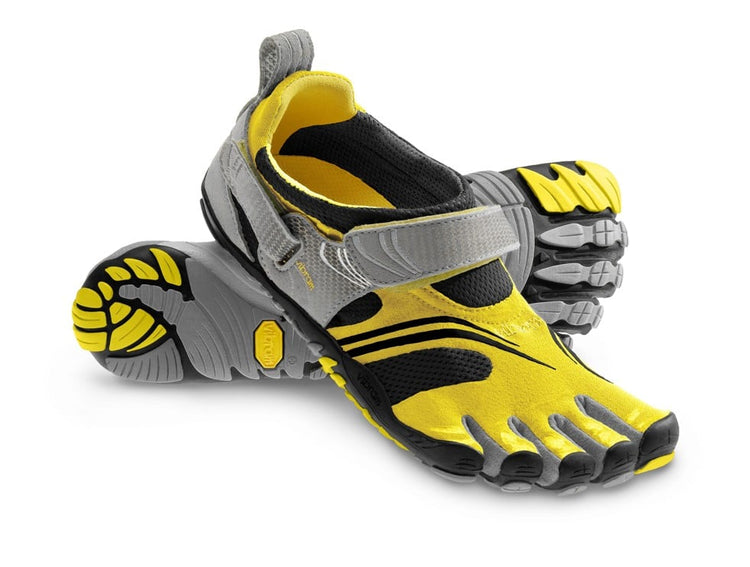
Will Vibram Fivefingers make your feet stronger?
Big news today in the barefoot world: Vibram settled a class action lawsuit that claimed the company deceived customers when it claimed that VFFs would decrease foot injuries and strengthen foot muscles.As reported in the Washington Post:The company agreed to put aside $3.75 million to pay refunds of as much as $94 to anyone who had bought a pair since March 21, 2009, according to Runner’s World.(Okay that was according to Runner's World as reported by the Washington Post. The Post article was the one that showed up in my newsfeed.)Further:Vibram has agreed to discontinue to make any claims that FiveFingers footwear is effective in strengthening muscles or reducing injury in its marketing and advertising campaigns, unless the company discovers new scientific evidence that proves it.This suit, and Vibram's response bring up some interesting questions.Is settling in any way an expression of guilt? Not according to Vibram:Vibram expressly denied and continues to deny any wrongdoing alleged in the Actions, and neither admits nor concedes any actual or potential fault, wrongdoing or liability,” read the court brief.While it's true that settling a lawsuit does not equate to guilt, it's kinda hard to argue that Vibram made the claims and, in fact, didn't have scientific evidence to back them up.This is similar to when Reebok and Skechers paid up after claiming their "toning shoes" would help you lose weight and firm up your butt. Those companies had to pay 25-40 million to settle their suits.Is the settlement appropriate?Let's be honest, $3.75 million is barely a slap on the wrist for a company that sold hundreds of millions of dollars worth of shoes. In fact, this is barely a tap on the arm hair on the back of the wrist.Agreeing to pay less than $4 million is clearly a payment just to make the case go away. Had they moved forward, the case could have cost tens of millions of dollars; so settling is usually a matter of cost-benefit analysis.What about the claims? Are they true?Well, here's where it gets interesting. Many people online, including on our Facebook page are, I think, confusing the issue.The question isn't whether being barefoot or, in this case, somewhat minimalist, can be helpful. Or whether you can strengthen your feet and reduce injuries by ditching your shoes.That's been my experience, and we've received hundreds of emails from Xero Shoes customers who report the same.But that's not the point.The point is: there's currently no scientific evidence to back up the claim. And if you can't prove it, you can't claim it in your advertising. That's the law. Making unsubstantiated claims can lead to "unfair enrichment."Is it fair?Ah, another interesting point. Shoe manufacturers have been making similar unsubstantiated claims for decades (more than Reebok and Skechers, mentioned above). But they haven't been taken to task for it.In my opinion, the only reason they haven't had to pay the piper is that there were never enough people who got all in a tizzy about their claims. People, by and large, just write off shoe company claims that their shoes will make you bigger, stronger, faster, as hyperbole.There was never enough mass, concentrated, public outrage to inspire someone to take action, like filing a class action lawsuit.I think the sudden and meteoric rise in interest in barefoot running, combined with claims like Vibram made, created a "perfect storm" for this kind of situation.Frankly, I'm surprised nobody has followed this with suits against other companies who've acted the same way.FWIW, Lena and I have been as diligent as possible about not making health claims, despite our experience and that of our customers, just because we knew the law. In fact, the FTC has gotten more stringent in the last few years, where companies have to be careful about even letting customers report their own experiences, since those can, arguably, be interpreted as a way of making unsubstantiated medical claims.Is this just another "McDonald's coffee" case?I've read this a lot.People comparing this suit to the one where Stella Liebeck sued McDonalds after getting burned by spilling hot coffee on herself.They say things like, "Hey, just because you went out too fast, too soon, don't go suing Vibram for your stupidity."First of all this isn't the same because the suit is a class action suit. Rarely do those result in windfall payments to the plantiffs.Secondly, it shows a misunderstanding, a common one, about Stella's suit. While people think Stella was just suing to make up for her stupidity, that's far from the case. The real issue behind that suit was that McDonalds had admitted to numerous instances of heating their coffee too much, resulting in injuries to other people, and despite that, hadn't taken any action to address the situation. More, people think Stella sued for and received WAY more money than she did. She just wanted her medical bills covered.The point being, even if Valerie Bezdeck, who brought the suit against Vibram, sustained injuries after wearing her VFFs, that's not the issue. The issue is: Can a company make unsubstantiated claims about a product? And while the answer is, "No," Vibram didn't have a day in court to argue this point.If they had, though, it might have been tricky since perhaps the most well-known study seemed to show that VFF wearers are more likely to get injured than regularly shod runners.I've previously commented on that study, BTW, and said that the real issue was the transition plan recommended by Vibram and followed by the runners in the study, compounded by the fact that the VFFs have enough padding that they decrease the sensations necessary to naturally change your gait (because you can't feel what hurts until it's too late).Is this the end of barefoot?This is the part that still irks me.Any time there's ANY news that suggests being barefoot and barefoot running will not improve your life, end world hunger, and land a man on Mars, it's written as if it's an episode of To Catch a Predator.Granted, the Washington Post article doesn't do this and, in fact, presents the reality of barefoot running perfectly:Does Vibram being caught flat-footed mean there’s no merit to barefoot running? Absolutely not. There is conflicting research on the subject, but I’ve met dozens of people who gave up the sport because of leg injuries suffered in traditional running shoes, only to have their exercise regimens revived by the minimalist variety. In fact, I’m married to one. There’s a niche for flatter-soled running gear, just as there’s a market for people who prefer to drive Maseratis instead of Mazdas.I would, of course, say barefoot is the Maserati in this analogy and that even though minimalism is currently a niche, it should be much more.But I also agree that the research needed for us to be able to make the kinds of claims that many of us have experienced isn't there yet. And, so, caution is necessary for those of us in the commercial space. And I am not claiming that your flat feet will develop arches the way mine did once I started going barefoot and in Xero Shoes.;-)What do you think?The content of this post does not constitute and is not intended to be a substitute for professional medical advice, diagnosis or treatment. Always seek the advice of a physician or other qualified health provider with any questions or concerns you may have about your health or a medical condition.

Happy Born to Run release day!
May 5th is an important day in the barefoot running world. And, for the same reason, it's one of the most important days in the Xero Shoes world.What makes it so important?As Brian Metzler from Competitor.com reminded me, "Journalist Christopher McDougall’s best-selling book “Born to Run: A Hidden Tribe, Superathletes, and the Greatest Race the World Has Never Seen” hit bookstore shelves five years ago Monday—on May 5, 2009."Brian describes 11 ways that Born To Run influenced the running world, from simply being a really great read, to inspiring the growth of ultrarunning, to creating a number of great races, to inspiring people to run barefoot, to encouraging shoe companies to make minimalist footwear (of course, if you've read anything I've written, you know I think most "minimalist shoes" are as close to barefoot as a pair of stilts).The 12th way that Chris's book influenced the world is that it was one of the inspirations for Xero Shoes.If you've read Lena's and my story, you'll know how BTR inspired us. But, more, the success of the book created a wave that we surfed. Were it not for the millions of people who read BTR, Xero Shoes would have remained a goofy little hobby.Now, on days when we work 12+ hours, I sometimes long for those hobby times ;-) ... but given the thousands of people we've been able to help -- people who can now run or walk or hike enjoyably and pain-free -- and the fun we have when a new person discovers the fun of being able to feel the world when they're out and about, we couldn't be more thankful for this anniversary.Congrats again to Chris for his success. Thanks again to him for all he's done for ALL of us. And stay tuned and cross your fingers for the Born To Run movie!
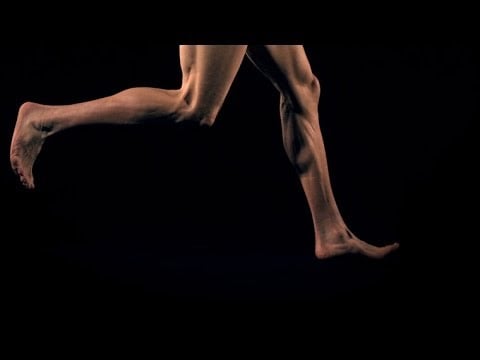
Is your body optimized for running?
Harvard's Daniel Lieberman is one of the two or three people most responsible for the barefoot running boom (Christopher McDougall, who wrote Born to Run, is another... you can vote for who the third should be).Daniel is an anthropologist and has some fascinating ideas about why the way humans run (and sweat) gave us such an evolutionary advantage.In this video he talks about some of aspects of human anatomy that suggest we were "made to run."I don't agree that you don't use your butt when walking. Rather, you can and, in my opinion, should walk with your glutes. In fact, if you use your glutes as the prime movers when you walk, you're more likely to not overstride and put too much force on your heels when walking. I talk more about walking, barefoot or otherwise, here.Now, I don't think that everyone must run. Some like it, some don't. And I don't agree that we're all meant to run long distance (Lieberman doesn't discuss that here, but it's something he and I chatted about). But it sure is compelling to see that we may be built so that we CAN run.What do you think?The content of this post does not constitute and is not intended to be a substitute for professional medical advice, diagnosis or treatment. Always seek the advice of a physician or other qualified health provider with any questions or concerns you may have about your health or a medical condition.

Amuri Cloud Webinar
Have questions about the new Amuri Cloud, or any Xero Shoes product, or anything about barefoot running?Then join me on a live webinar where I'll answer 'em all.When: Thursday, March 27th at 6pm PT (that's 7pm Mountain time, 8pm Central time, 9pm Eastern).Where?Online -- Click Here to join us!

I dare you to run barefoot! Or bigfoot. Or both!
What inspires someone to take off their shoes and run barefoot?For Khanh Nguyen it was knee pain and the hope that barefoot running would help.Once he got started, in bare feet and in Xero Shoes, he was on fire. He's run 1/2 marathons, mud races and, most recently, he ran UP the Stratosphere Hotel in Las Vegas in his Xero Shoes. AND, he did it in our Bigfoot, the Xero Hero costume!Enjoy this really fun interview with Khanh, and see what motivates him to run (hint: his brother dared him!)
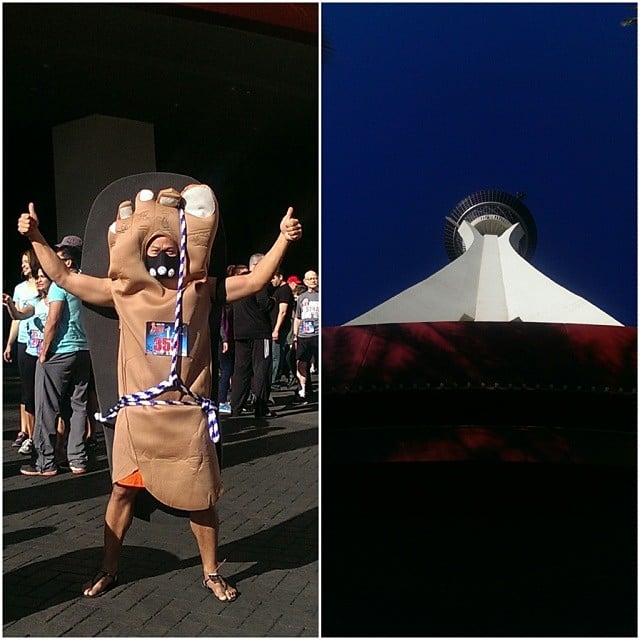
Bigfoot wears barefoot shoes? Yup.
Have you seen bigfoot?If you were in Las Vegas on March 2nd at the Stratosphere hotel, you probably did.In fact, you may have seen this mysterious barefoot beast climb the Strat!While most people who claim to see bigfoot have grainy, fuzzy pictures or video, we have high-resolution proof of his existence. And, even more, we have proof that Bigfoot wears barefoot running shoes. Xero Shoes, to be exact!Here's a pic of the legendary monster at the base of the Stratosphere (that's looking UP the building). You can see his barefoot footwear (and his elevation training mask, which scares off the easily upset).Then, just a short time later, Bigfoot was spotted at the top of the hotel! Apparently happy that he's avoided capture yet again.In reality, this is our friend and Xero Shoes athlete, Khanh Nguyen, dressed as Bigfoot, the Xero Hero. Khanh scaled the Strat as part of a fundraiser to support the American Lung Association. You can add your support by clicking here.
Does Barefoot Running Cause Calf Pain? - Xero Shoes
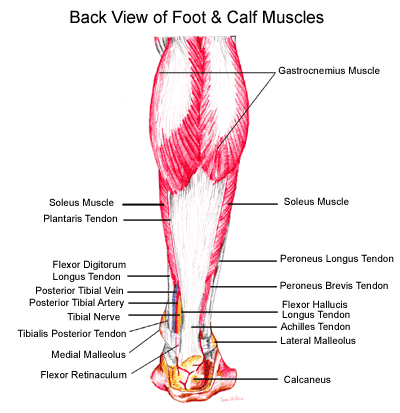
People making the transition to running barefoot or in minimalist shoes sometimes experience calf pain or even calf injuries. They can also feel pain in their Achilles tendon.I have talked with plenty of people who assume this kind of pain is just part of the transition process from running in typical running shoes to running barefoot or in minimalist shoes.If you’ve heard this, too, I have good news for you:Pain isn’t a necessary part of the process!I like to say “calf and Achilles pain is optional” (if you know what to do).I am going to first give you an overview of why runners might experience calf pain in the first place before turning to barefoot running and why I think the conventional wisdom here is wrong.Why We Get Achilles Tendon and Calf Pain when RunningYour calf has a set of muscles (including the gastrocnemeus and soleus muscle) that connect to the Achilles tendon and provide both the power for pushing with your foot, as well as controlling how your heel comes down to the ground if you land on the ball of your foot.The most basic reason runners experience calf pain is overworking the muscles and tendons.This can happen for a variety of reasons. In some cases, it is because they were used to apply an amount of force the muscles are not used to. For instance, if you’re used to running on flat surfaces but then go for a run on a hill, your calf muscles are going to be working a lot harder than usual. This can also happen with a sudden increase in distance.In other cases, it isn’t that the force is too much but that it goes on for so long. To put it differently, the muscles are pushed past their point of endurance.Sometimes, a runner’s calf muscles have simply been asked to work before a proper warm up or stretch. Tight calves that are suddenly put to work places a lot of strain on the muscles.Whatever the reason, pain is your body’s way of telling you that your muscles need a rest, and that you probably need to use your calves differently once you’re feeling better.Sore calves are a normal effect of exercise and nothing to worry about. Severe calf pain, on the other hand, is an indication of a more serious problem. If you overwork your calf muscle, you risk injuries like a calf strain or even a calf tear. Muscle tears are painful and can require a long recovery process.In short, then, tendon or calf pain is an indication that you’ve overdone it in some way.Why People Assume Calf and Tendon Pain Are Just Part of Barefoot RunningWhen you run barefoot, you run differently than if you’re in typical shoes (get tips on how to run barefoot here). Generally speaking, runners who are used to thick, modern running shoes will tend to land heel first with their foot contacting the ground well in front of their body.Once making the switch to either no shoes or minimalist ones, most runners will probably stop landing that way. Why? Because it hurts to land on your heel!Instead, barefoot runners will tend to adopt a mid-foot or fore-foot strike pattern, landing with the heel initially off the ground. In that running form, the calf muscles act as shock absorbers, controlling the speed with which your heel comes down to the ground (or near it). This “eccentric” or “negative” loading can place greater demands on calf muscles and tendons than they used to.It makes sense, then, that transitioning to barefoot-style running could lead to overworking of the calf muscles and therefore to calf pain and soreness.Most people think the issue is that the calf muscles are too weak because of previous underuse and the solution is to make the calf muscle stronger.In other words, people believe that calf and Achilles soreness is practically inevitable when you try running barefoot, and that building strength is the eventual cure.But that story is missing something important.Why Calf and Tendon Pain Are AvoidableI say that it is missing something and not that it is totally wrong.It is true that barefoot running usually means a new (and more natural) running technique that can place more demands on the calf muscle.But this doesn’t need to lead to calf pain when running.The most common problem many runners have when they begin to run barefoot is that they simply use more effort than necessary when they run.Consider that there are two ways to keep your calf muscles from being overworked: to have stronger muscles for a given amount of work or to reduce the work required. Runners usually assume they need to do the first thing – build up their calf muscles with strengthening exercises.From what we’ve seen, having heard from tens of thousands of new-to-barefoot runners, the “secret” to reducing your odds of having calf pain is to do less and relax more.So let’s take a deeper look at this other option: to prevent calf pain or calf injury by reducing the amount of work you ask your calves and Achilles to do.The Common Mistakes Barefoot Runners MakeOkay, so how do we do less and relax more?It all comes down to form.New barefoot runners often have two other habits that put unnecessary strain on their muscles and tendons, putting them at risk of calf muscle injuries:Overstriding while landing on the mid-foot or ball of the footMost new barefooters hear that you should land on the ball of your foot, or on your midfoot.It’s true. BUT, the mistake many make is using the same form they have in regular shoes – landing with their foot in front of their body (“overstriding”), and then merely pointing their toes.When you land with your foot further in front of your body, you’re basically “putting on the brakes” which puts excessive force on your foot.If you point your toes to land on your forefoot, you use your calf and Achilles to decelerate and this amount of force is more than most people’s calves can handle. In fact, it’s more than the bones of your foot are made to handle so you’re also risking a stress fracture.Sure, getting freakishly strong may make that easier to do, but the correct solution is to “stop putting on the brakes” when you land by stopping your over-striding and, instead, placing your foot more underneath your body when you land.By not applying that breaking force, your calves don’t have to do as much work.One way to learn to land with your foot underneath you is by increasing your cadence – the number of steps you take per minute – without running faster. This quicker cadence makes it harder to overstride.There’s actually a recent study on this. Researchers found that runners with a history of recurrent calf strain injuries land with their heels further away from their center of mass.Pushing OffSimilarly, if you remove your foot from the ground by pushing off with your toes, you’re essentially doing bodyweight calf raises every time you take a stride… and even a short run would be more than your body can handle.Again, the solution isn’t to hit the gym to lift weights or cross train to improve your calf raise strength. It’s to LIFT your foot off the ground (instead of pushing) by flexing at the hip.I know that sounds weird, so let me give you an image to help it make sense:Imagine what happens if you stepped on a bee and it stung your foot… you wouldn’t try to push away from the ground since that would drive the stinger further into your sole. You would reflexively (faster and easier) pull your foot from the ground with a hip flex.You want to use that same hip flex to get your foot off the ground when you run. You’re still using your calf muscles, but not nearly as much as you do by “toe-ing off.”How to Find the Right Running Style that Won’t Lead to Tendon or Calf StrainIn order to use less effort, you’ll probably have to start with less running.That’s fine.Even when you make the adjustments I just described, barefoot running will have you using your lower leg muscles in new ways that will take some time to get used to.The key thing at this early stage to prevent calf injuries is to be patient and listen to your body. Calf tightness isn’t something to worry over. Make sure you are warming up with some calf stretches to keep loose.On the other hand, sharp pain in your feet or calves, shin splints, calf strains — these are all clear messages from your body that something isn’t right. You may even find that you are getting calf pain in your left calf but not your right calf. That can be an indication that you are getting it right with one leg but not yet the other.If you are willing to take it slowly and make adjustments, it is just a matter of time before you find the running form that will feel easy and fun.And you’ll find that you will be able to run your usual distances and times sooner than you think.By the way, it isn’t just calf pain that is a potential issue. Running injuries like plantar fasciitis and shin splints are common, and researchers suggest an important risk factor is increases in the volume or pace of training. Injury prevention requires respecting your body’s limits.By the time you figure everything out, you will probably have gained any extra strength you need.Barefoot Running…in Shoes? I have mentioned minimalist shoes in this article about running barefoot and calf pain. Maybe that confused you. If so, let me explain.Barefoot running is all about recovering a natural running form that allows our bodies to function the way they are designed. It seems obvious that doing what’s natural is better for our bodies. It’s also a lot more fun. It’s really more about how your feet move than about what you have on them.It’s about the form, not the footwear.There is a relationship between the two, however. Minimalist shoes (also called barefoot shoes) are designed specifically to give you the flexibility and feedback that let you maintain natural movement without you having to walk around in bare feet. So you can absolutely try barefoot walking or running without having to ditch footwear, as long as it’s the right footwear.We’ve put together a handy tool to help you find the perfect pair of barefoot shoes (or sandals) for you. Why not have a look?The content of this post does not constitute and is not intended to be a substitute for professional medical advice, diagnosis or treatment. Always seek the advice of a physician or other qualified health provider with any questions or concerns you may have about your health or a medical condition.

This baby means business... bare footed business
I totally want to work for this kid!






